
AI × China Supply Chain × Global Local Service Network → From Product Supply to System Solutions
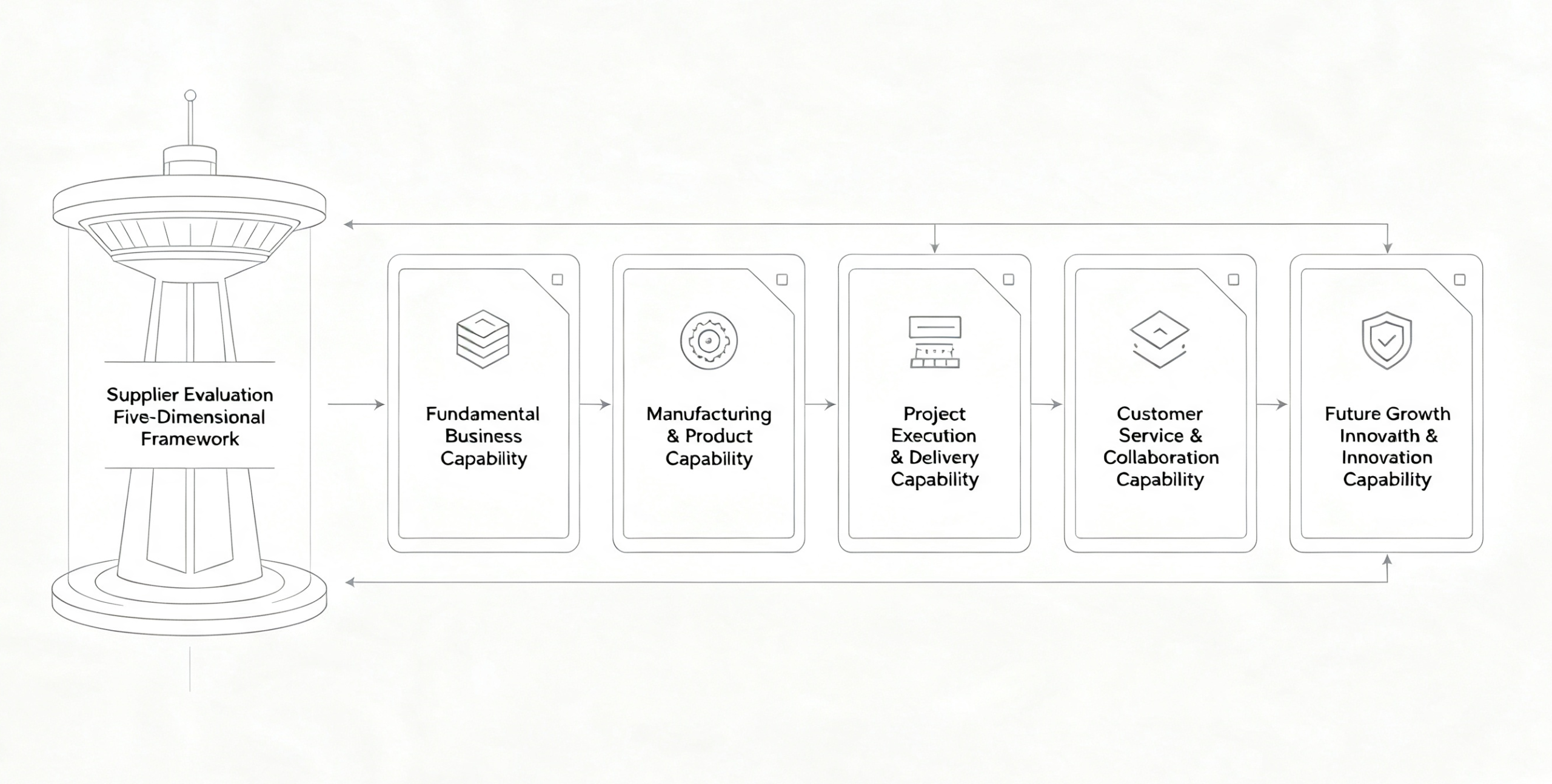
Selecting the right supply chain partner requires a structured and professional evaluation framework. The core objective is to determine whether a potential supplier can consistently meet a buyer’s long-term requirements in key areas, including communication efficiency, production capacity, quality management, R&D capability, requirement understanding, delivery performance, lead time reliability, pricing competitiveness, and after-sales support.
A comprehensive supplier evaluation process helps global buyers identify reliable manufacturing partners, reduce supply chain risks, improve procurement efficiency, and build long-term cooperation with trusted suppliers.
The supplier evaluation system mainly focuses on the following five key dimensions:
✓ Fundamental Business Capability
✓ Manufacturing & Product Capability
✓ Project Execution & Delivery Capability
✓ Customer Service & Collaboration Capability
✓ Future Growth & Innovation Capability
1 Fundamental Business Capability
1.1 Factory Authenticity Verification
Some suppliers are actually trading companies without real manufacturing facilities. In some cases, they may temporarily install company logos, signs, and branding at a partner factory when overseas customers visit. Such suppliers cannot be considered genuine manufacturers.
Verifying factory authenticity helps buyers identify real production capabilities and reduce supply chain risks.
1.2 Supplier Operating History & Industry Experience
Generally speaking, the longer a supplier (under the same legal entity) has operated in a specific industry, the more likely its products and services have been validated by the market. Suppliers with poor product quality or unreliable operations are usually eliminated quickly due to market competition.
1.3 Financial Health & Business Stability
Financial stability is often overlooked but is a critical factor in supplier evaluation. A financially healthy and profitable company usually indicates reliable product quality, stable operations, and stronger delivery capability. Suppliers with poor cash flow or continuous losses may face higher risks, including quality issues, production delays, and failure to fulfill international customer commitments.
1.4 Legal Dispute & Litigation Status
A supplier with frequent legal disputes may indicate potential business risks. A high number of cases as a defendant may reflect issues related to business integrity, contract performance, or operational management.
A high number of cases initiated as a plaintiff may indicate weaknesses in risk control, supplier management, or commercial operations.
1.5 Compliance Certifications & Regulatory Qualification
Compliance certifications represent the basic requirements established by governments and international markets.
For many industries, especially those involving international trade, suppliers with existing global certifications can significantly improve delivery efficiency, reduce compliance risks, and accelerate market entry.
1.6 International Business Experience
Lack of international customer experience is not necessarily a major disadvantage.
However, suppliers with international business experience usually have better knowledge of export procedures, customs requirements, documentation processes, logistics coordination, and specific market requirements, enabling smoother global cooperation.
2 Product Manufacturing Capability
2.1 Production Capacity Assessment
Evaluating a factory’s current production capacity and capacity utilization rate is essential to determine whether it can consistently meet the buyer’s order requirements. A supplier with insufficient available capacity may face production delays, missed delivery schedules, or difficulties handling increased demand.
2.2 Quality Management System
A supplier’s quality management system reflects how it controls and maintains product quality throughout the manufacturing process. Key evaluation areas include raw material inspection, production process control, quality checkpoints, testing procedures, and continuous quality improvement mechanisms.
2.3 R&D Capability & Engineering Strength
A genuine R&D capability is different from a production assembly capability. Supplier evaluation should not only consider patents, but also the size and structure of the R&D team, R&D investment shown in financial reports, product development capability from concept to mass production, and independent design capabilities in areas such as mechanical structure, software, and electrical systems.
A complete technical documentation system is also essential. Many factories appear to have strong R&D capabilities, but in reality only focus on manufacturing and assembly.
2.4 Production Efficiency & Manufacturing Productivity
Production efficiency measures how many units a factory can manufacture per day or per hour. It directly affects delivery speed, production flexibility, and the ability to handle urgent orders.
Unlike overall production capacity, production efficiency reflects the factory’s operational effectiveness and manufacturing process optimization.
2.5 Material Utilization Rate & Manufacturing Efficiency
Material utilization rate reflects a factory’s technical capability, cost competitiveness, and production yield. A higher material utilization rate indicates less waste caused by defects, improved manufacturing processes, better cost control, and stronger technical maturity.
2.6 Product Warranty & Quality Commitment
A longer product warranty period can indicate stronger confidence in product quality and reliability.
However, warranty capability should be evaluated together with the supplier’s financial health, operating history, and long-term business stability to ensure the supplier can effectively fulfill warranty commitments.
3 Project Delivery Capability
3.1 Production Scalability Capability
The key point is not the theoretical production capacity, but the supplier’s available capacity under current order conditions.
A reliable supplier should be able to explain whether it can increase production capacity when orders suddenly increase by 10%, 30%, 50%, or even 100%, and how long the expansion process would take.
3.2 Production Planning & Management Capability
A professional manufacturer should have a mature production planning system, including a dedicated PMC (Production Planning and Material Control) department, ERP/MES system, production scheduling process, and real-time order tracking.
The key evaluation point is how the factory ensures the promised delivery date after receiving an order. Leading manufacturers do not simply produce products first and inform customers afterward.
Instead, they develop a complete execution plan from customer orders, including material planning, production scheduling, key milestone tracking, quality inspection, packaging, and shipment preparation, with clear timelines and responsibilities.
3.3 Raw Material Supply Assurance
Many delivery failures are not caused by production limitations, but by material supply issues. Evaluation should focus on the number of key suppliers, availability of backup suppliers, critical material inventory cycles, and advance material preparation.
The key question is: if a core material supplier is delayed for 30 days, what alternative solutions does the factory have to maintain delivery commitments?
3.4 On-Time Delivery Performance (OTD)
Historical delivery data should be reviewed, including OTD (On-Time Delivery) rate, delayed order percentage, and average delay duration.
Many small and medium-sized Chinese manufacturers may not have formal delivery performance statistics, but their reliability can often be indirectly evaluated through customer repeat orders, long-term partnerships, and customer retention.
3.5 Production Process Stability
This evaluates whether product quality and delivery reliability depend heavily on individual workers’ experience. Key evaluation areas include Standard Operating Procedures (SOPs), manufacturing documentation, process parameter control, automation level, and employee training systems.
If different workers can consistently produce products with stable parameters and standardized processes, the supplier has lower delivery risks and stronger manufacturing reliability.
3.6 Delivery Risk Early Warning Capability
Strong suppliers do not wait until delays happen. They identify potential risks in advance and proactively communicate with customers. For example, if raw material delays occur, they should notify customers early and provide alternative solutions.
Evaluation focuses on whether the supplier actively communicates, provides risk alerts, and proposes practical solutions.
3.7 Packaging & Logistics Coordination Capability
This focuses on export experience, packaging standards, international shipping requirements, logistics partnerships, customs documentation capability, and experience with special transportation requirements such as dangerous goods shipments.
Strong logistics coordination capability helps ensure smooth international delivery and reduces export-related risks.
4 Customer Service Capability
4.1 Customer Requirement Understanding Capability
Many supply chain problems are not caused by suppliers lacking products, but by suppliers failing to truly understand why customers need those products. Customers are not simply purchasing an isolated product; they are seeking solutions for specific application scenarios.
An excellent supplier should proactively understand the customer’s background, application environment, business objectives, and real challenges, then provide professional recommendations.
Key evaluation question: Is the factory only fulfilling customer orders, or is it helping customers solve real business problems?
4.2 Solution Design Capability
Future industrial procurement competition will no longer focus only on selling products, but on providing complete solutions. Customer requirements are becoming increasingly complex and usually involve a combination of products, technical solutions, application recommendations, and service systems.
Evaluation should focus on whether the supplier has technical solution capabilities, product integration capabilities, customization and development capabilities, project experience, and cost optimization capabilities.
Key evaluation question: Is the supplier simply selling products, or helping customers achieve their business objectives?
4.3 After-Sales Service Capability
For industrial products, completing a transaction is not the end of cooperation; it is the beginning of a long-term partnership. A purchasing decision directly affects future operational risks. Customers are not only buying equipment; they are buying long-term reliability and operational assurance.
Key evaluation areas include after-sales service teams, technical support capability, spare parts management, overseas service capability, response speed, and warranty policies.
Key evaluation question: After the product is delivered, does the supplier still have the willingness and capability to take responsibility?
4.4 Communication & Collaboration Capability
The biggest hidden cost in international supply chains is often not product price, but communication efficiency and trust-building costs. Many projects fail not because of technical problems, but because of poor communication and collaboration.
Excellent suppliers demonstrate fast response, proactive communication, transparent information sharing, problem-solving attitude, and willingness to work together with customers. Key evaluation areas include response speed, communication quality, cooperation attitude, problem-solving approach, information transparency, and willingness for long-term cooperation.
Key evaluation question: Is this supplier only a short-term transaction partner, or a reliable long-term strategic partner?
5 Future Growth Capability
5.1 Digital Management Capability
Future supply chain competition will gradually shift from experience-driven management to data-driven management. Excellent suppliers need to digitally manage key operational data, including production data, quality data, order data, inventory data, cost data, and equipment data. In the future, customers will need more than just products; they will need real-time visibility and predictive insights into supply chain performance.
Key evaluation areas include manufacturing digitalization, ERP/MES systems, production data tracking, quality databases, traceability systems, delivery risk prediction, and order status transparency.
Key evaluation question: Is the supplier simply managing a factory, or managing a data-driven manufacturing system?
5.2 Innovation Capability
Industrial markets are changing faster than ever. If a supplier can only manufacture existing products according to customer requirements without continuous improvement, its long-term value will gradually decline.
Truly competitive suppliers should have the ability to continuously create new value based on market changes and customer needs. Innovation is not limited to new product development; it also includes process innovation, such as improving automation levels, and service innovation, such as remote monitoring, predictive maintenance, and regular inspection services.
Key evaluation areas include the percentage of new products developed annually, technology roadmap planning, future market analysis, and the ability to proactively provide improvement suggestions.
Key evaluation question: Is the supplier only meeting today’s requirements, or helping customers prepare for future opportunities? This capability is critical for long-term strategic cooperation.
5.3 Ecosystem Collaboration Capability
More and more industrial products are becoming complex systems rather than standalone products. Problems in any part of the value chain may affect the final customer experience. Therefore, future leading suppliers should not only focus on their own products but also coordinate industry resources and collaborate with partners to solve customer challenges. Strong suppliers can help customers connect with relevant resources across the supply chain ecosystem.
Key evaluation areas include upstream and downstream resource capabilities, partner networks, willingness to share resources, joint development capabilities, and ability to participate in system-level solutions.
Key evaluation question: Is the supplier an isolated manufacturer, or an important node within an industrial ecosystem?
5.4 Market Understanding Capability
Excellent suppliers should not only understand “what customers buy”, but also understand “why customers buy.” This is especially important in international markets, where customer requirements vary significantly across different countries and regions.
Suppliers without market understanding may face problems such as product mismatch, insufficient certifications, difficult after-sales support, and unsuccessful market expansion. Key evaluation areas include understanding of target markets, overseas project experience, industry trend research, customer business model understanding, and ability to provide market recommendations.
Key evaluation question: Is the supplier simply waiting for customers to tell them what to do, or can they proactively help customers identify new opportunities?